About The Work Room

The Work Room is the Creative Journal of Wendy Sue where she shares her creative journey in all things handmade. The Work Room also offers an alternative to your typical jewelry making workshops. Scroll down to the end of the page to see how you can learn to make your unique piece of artisan jewelry online.

Saturday, 28 March 2009

Leaving on a jet plane ......


Keeping this a really short one. I'm writing this post from KLIA, actually, while waiting for the boarding time. Plane's leaving at 11:40 pm. More when I reached UK.... ;)

post signature

Read More...

Tuesday, 24 March 2009

Bead reamer

..................................................................................................................................................................................................................................................,.........
Work Room chat:
Here's an interesting article on an understanding of pearls; What you should know before buying pearls.

..................................................................................................................................................................................................................................................,.........

One of the type of beads that I use a lot, apart from Swarovski crystals, is freshwater pearls. Unlike faux pearls, freshwater pearls are organic bead and the thing about some organic bead is that they tend to have holes which are smaller. Which is why you may notice that when you buy these beads in strand, freshwater pearls are strung onto a piece of thread, unlike gemstone beads which are strung onto a piece of fishing line.


The head pins and eye pins sold in the market on the other hand comes in varrying wire thickness; or gauge as the correct term; and more often than not, the gauge of these head pins and eye pins are rarely stated. Nevertheless, I think you can safely assume the gauge of most of the head pins and eye pins sold on the market are of 0.7mm. Occasionally, you might also get some with lesser gauge.

Well, this might not be something that a beginner would take notice of but the problem with working with frehwater pearls with these commercial head pins and eye pins, there is always the high probability that you might find that these head pins or eye pins not being able to go through the pearl bead.

When I couldn't understand the situation, I blamed it ont the pearl bead. I was pretty much cursing the manufacturer of the pearls as I was forcing the pins through the bead! LOL.....
With some force, sometimes I managed to get them through and sometimes not. Bottom line is, it was frustrating because buying them online means there is no way that you'll know for sure that the pins will go through the hole.

Little did I realize though that it has actually got much to do with the pins. But then I know that there is no way that I can change the gauge of the pins. If only I could make the holes bigger.......now, that's something possible.


This bead reamer is pretty sophisticated looking, right? ;P You sure can't get more pro looking than this..... LOL.......


This is a picture of other types of bead reamer I found on the net. But mine is still cooler, right? :P


Anyway, this bead reamer tool I got is from Beadalon. The description reads:

“Three tools in one! Enlarge, de-bur, or round out bead holes. Three different tips are included, fitting bead holes from the smallest up to 5.0mm. Each tip is coated with diamond dust for smooth, even reaming..............”


So, exactly where are the so-called tips?


Jang! Jang!


I actually use more of the two at the bottom only to enlarge holes. The one at the top is used for de-bur and round out bead holes which I hardly use, if at all! What is meant by de-bur, is actually something like filing, to smoothen out surfaces but not for your wires. You’ll need a different tool for that.

So, how do you a bead reamer tool?

See the front of the tool, here?


Turn the head to loosen and open up the hole within.


Next, place the end of your chose tip into the hole.


Tighten the head to secure the tip at the front.


And there you have it! The bead reamer tool is good to go. See how the surface of the tip is coated with diamond dust which will enlarge the holes from the friction as you turn the tip inside the bead hole like this.


Pretty neat, huh? But this is going to set you back at


But this tool is not necessary at all if you uses wire. From past experiences, I can safely say that wires of 0.6mm thickness or 22 gauge and below will almost definitely go through all pearls, which is why I hardly use this anymore. It’s pretty much just something for my own collection. ;)

And just in case some are wondering...... no, you can’t drill holes with this. You need something else. :)


post signature

Read More...

Friday, 20 March 2009

One bead ring


This is another wire wrapped ring I made, but this time, incorporating a single round 8mm turqouise gemstone bead. I really like how the silver colour brings out the blue colour of the turqouise bead. This is similarly another fool proof piece and I do think they'll make a really nice gift. Especially when you needed one in a hurry! ;)

Here'a the video I referred to:


I hope you'll enjoy them just as much as I did! ;)

Ouh.....and in case you're wondering, I used 0.6mm wires for all the wire wrapped rings that I've made thus far. I reckon you could also use 0.4mm ones but you might just need to go around a few times more or 0.8mm if you want to try out Joan's version. 0.8mm might be too thick for wrappings.


post signature

Read More...

Tuesday, 17 March 2009

Silver polishing cloth

..................................................................................................................................................................................................................................................,.........


Work Room chat:
Here's an article which you might be interested to read on Cleaning Your Silver and another one on Keeping Silver From Tarnishing.

..................................................................................................................................................................................................................................................,.........

I almost forgotten about these. For those who are unclear of what this is, allow me to explain.


Silver polishing cloth is a piece of cotton cloth impregnated with silver polish and anti-tarnish agent to clean tarnish off silver and protect against tarnishing. To me, it’s good enough to clean off tarnish. The cloth remains effective as long as they are not washed. If you wash them, you wash away the chemicals impregnated into the cloth to clean the tarnish as well.

There is also other silver cleaning agent in liquid form. Basically, what you do with the liquid is to soak them in the liquid to clean the tarnish. Both works the same but probably just a matter of preference and practicality.

To me, rubbing with a cloth is much faster and more convenient that soaking them in liquid. But it might be more difficult to rub a chain or creaks of those components with intricate carvings and so on, in which case, it might be more practical to clean using the liquid form, if you are very particular. But if you are not fussy and don’t mind the extra work, I think silver polishing cloth work just as fine.


One of my common practices when using the wires is to give them a good wipe prior to use. It is also a way of straightening the wires. If you’ve seen any wire wrapping videos, one common thing shown in the video prior to any work done is how the wires are straighten with pulling the wires straight with hand. I just did mine with the silver polishing cloth instead of bare hands.

This is not proven or anything but just a practise I picked up because the wires are after all silver plated and I just thought that wiping it with the chemical impregnated cloth might help protect the wires a bit. Well, this is just my own idea, really


There is a story behind the silver polishing cloth actually.

When I first started selling the jewelleries that I make, one of the question that I got a lot was whether they tarnish. I was sort of in a catch-22 situation whenever this question was posed to me. I was afraid that if I said that it would, that I won’t be able to sell anything but yet on the other hand, I don’t want to lie to my customers. So, reluctantly, I would tell them that they would. Unsurprisingly, I did loose out on some sales.

I was pretty upset about this. Frankly speaking, how can they not tarnish at all? Even sterling 925 silver tarnish after some time and my jewelleries are not expected to tarnish? Seriously, are you kidding me?

Because it was something that was bugging me so much, I just couldn’t let it rest just like that. I made researched over the internet, asked in forum and I finally could come to a resolution.

No, I did not find any solution to stop or prevent the tarnishing process. It’s a fact of life that they WILL eventually tarnish. Like I said before, even sterling 925 silver and even white gold tarnished after some amount of use. Yes, there are no question that there are some non precious metal like surgical steel, stainless steel and what not that don’t tarnish but you should also realize that the silver colour on those metals are very much different from sterling silver.

What I realize later on is that to make your customer understands this just as how I am understanding it.

Yes, it will tarnish BUT how long it will last you depends on a few factors.

  • Treatment
    If you are going to wear that piece of jewellery 24/7, while you are bathing, sleeping and exercising and not expect them to tarnish, seriously? I’m really at a loss for words. Oil, sweat and dirt will all hasten tarnishing. That is why the wearer is advised to apply lotion, perfume and so on prior to putting on the jewellery and take them off first before cleaning up. In other words, jewellery should be the last to put on but the first to take off. And also, due to the fragile nature of handmade jewellery, wearer is also advised to treat them gently. How and where you store the jewellery also matters because dust is also another factor that hastens tarnishing.
  • Quality
    The quality of the components used is also a factor. This, I think, is self explanatory. Better quality components will no doubt not tarnish as fast as the lower quality ones. Honestly, this itself is no guarantee as sometimes the maker would not even have known about it until the customers complain. All I can say is that this is sometimes, something we can only learn through experience, after using them; talking from a maker and buyer point of you. If you are happy with the components you bought, there will be repeat order. If you are unhappy with the quality, you stop purchasing from them but I do think that in such circumstances, we sometimes need to give the reseller the benefit of doubt because they sometimes also only learned about the quality of the components, or lack-of thereof, after feedbacks from customers.
  • Weather
    A hot, humid climate encourages faster tarnishing as well and so is being near to the oceans will equally makes jewelry tarnish faster.
  • Body chemistry
    This is something I learned from my Sa Kor when I told her about my dilemma with the tarnish problem. I was from her that I learn that some bodies tarnish metal faster than others. Metals can react differently on different persons. Sometimes this is because of a person's body chemistry, other times it might be because of what type of soap or lotion or perfume a person might use. That was the very first time I was hearing about it but according to her, that seemed to be the common sentiment accepted by the people there and so people over there, as in the UK, are more forgiving(?) and silver polishing cloth is therefore a given.
  • Maintenance
    That was how I learned about the silver polishing cloth. I don’t really understand what the commotion should be when the tarnish can be cleaned. That is the whole idea of silver polishing cloth. You rub your jewellery with the cloth to remove the tarnish and also to slow down future tarnishing. It’s the idea of upkeep and maintenance. It’s like doing facial? Compare someone who goes for facial once a month to someone who only goes for facial once in 6 months, who do you think will have a better skin?


It’s also sometimes an issue with knowledge and education. As much as I’ve come across customers who question me on tarnish, I’ve also got customers asking me about how to care for their jewelleries to maintain their sparkle. They’ve also heard vaguely about some cloth or liquid to clean and asked me for further details. That is what I call smart consumer.

So, this is my conclusion; how quickly or badly they will tarnish depends on how much you wear them, how you wear them and where you wear them. The concept is simple. If you want something to last longer, you just need to as far as possible maintain its condition as you first received it.

If you hated all the maintenance work that inevitably comes with sterling 925 silver, argentium sterling silver might just be what you need. Argentium sterling silver, I heard, is highly tarnish resistant.


post signature

Read More...

Saturday, 14 March 2009

The curious case of button rings


The buttons I'm referring to here those sewing buttons; bottons for your clothes.


Yes, these are the type of buttons I'm talking about. But then, I'm not interested in those. I'm interested in buttons of this type.


Notice the difference between the two types of button? The ways in which you'll be sewing the button onto the garment are different. For those buttons in the first picture, the thread actually shows through the holes but for those bottons in the second picture, the thread is hidden from view, behind the button because your thread goes through the loop thing behind the button to attach the button onto the garment.

Ok, I'll stop yakking about the different ways buttons are attached to a piece of garment here or this shall turn into a discussion of sewing techniques. Lol..... XD

My point is, you'd be surprised at how amazingly beautiful and intricate the design of some of these buttons are. Did you know that some buttons are even collectors item? Cool or what?


So beautiful that you can even turn them to a piece of jewellery, like what Joan did with this piece of a beatiful button here.


Joan recently bought some of those European made silver plated wires from me and told me about this ring that she made.


But what I thought was really clever about this ring was how she made the ring band an adjustable one.


A one size fist all ring! How ingenius! :)

I actually came across this video on YouTube some time back already. Wire wrapped ring but with a button as its focal. The same wire wrapping method with the two rings I made earlier on.


28 gauge is approximately 0.3mm and I personally do think that it's way too thin for wire wrapped rings and I don't quite like the finishing. Well, I believe you can also use 0.4mm for this since wires do harden after working on them but the problem with working with such fine wire is to be very careful not to kink them or they'll break easily. And also, since 0.4mm is thicker, presumably you would probably not need to go as many round as you would with the 0.3mm ones?

I still think Joan's idea of making the band adjustable a much cleverer one though....


post signature

Read More...

Thursday, 12 March 2009

Rosette ring


This is very simple, easy and straightforward to make. Very cute too with the rose motif right at the centre. This one is almost fool proof to make if you ask me! I got it right at the very first time and I honestly feel that there's no way that anyone can go wrong with this. This ring can be completed in under 5 minutes and I do think they make very cute rings for children. I think you can even embellished some beads on it to add a bit of colour and zest to it or maybe even vary it a little for a bolder design. Hhhmm... maybe I should try it out the next time.

Anyway, here's the video instructions to this rosette ring:


post signature

Read More...

Tuesday, 10 March 2009

Ways to wrap a tear drop bead

..................................................................................................................................................................................................................................................,.........
Work Room chat:
Briolette is another bead shape similar to that of a tear drop except that briolette bead is flat on one side whilt tear drop shape is round all over. Therefore, as compared to the tear drop bead, briolette can lay flat nicely on a flat surface whereas the tear drop bead tend to roll around. One very interesting way of using briolette is joining a few of them together to form a floral motif where each briolette looks like the petals of a flower. Find out how it is done with wire here.

..................................................................................................................................................................................................................................................,.........

When I first started making jewellery, I was rather fascinated with the tear drop bead. I’ve always thought that it was a very elegant shape. However, I had a problem. I didn’t know how to join it.

Prior to much knowledge on wire wrapping, common sense told me that using a jump ring is the most appropriate method I know of at that time. But due to the shape of the bead, it wasn’t an easy task after all. I could hardly attach a small size jump ring such as a 4mm one to it. I would need bigger sized jump rings. Even a 5mm jump ring seemed to me to be pushing it a little.

The main reason I don’t like using jump ring to attach a tear drop bead is due to the finishing it gives. Since I would almost definitely need a bigger jump ring to do the job, the end product looked a bit unrefined to me. Unless of course if I could use a smaller jump ring. But that’s not too likely to be the case, isn’t it?


I couldn’t find the exact picture I want. This was the closest that I could find. Just imagine the round bead being a tear drop bead.


The Japanese beaders, I’ve noticed uses a head pin instead. Basically what they do is insert a head pin through the hole. The head will act as a stopper on one side preventing the bead from sliding off. The other end of the head pin is the bent upwards to form a loop.

Here is a picture for illustration.


I gave this a try myself.
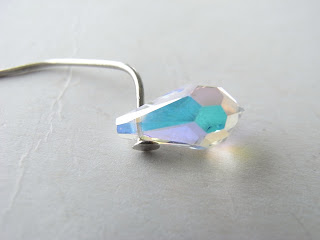


Quite frankly, I’ll have to say that I don’t favour this method at all. I sort of stopped after making the bend. I’m so worried that it might break the tip off that I just couldn’t bring myself to go ahead and finished it with a loop.

If any of you have used the Swarovski crystal tear drop bead before, you should realize the crystal is almost as fragile as glass where they will splinter or break if more than necessary amount of pressure is exerted. I’ve experienced a handful of broken tear drop beads that I’m beginning to be wary of using the bead.

But of course, that was all before me using wires. Now that I’m using wire already, I basically categorized the ways I use to wrap a tear drop bead into 2 methods.

Classic
I call this the classic method because this is probably the method you’ll generally find printed in any beading books or magazines or even online beaders forum.

Considered as one of the basics in wirework.

Here is how you do it.

Slide your tear drop bead in.


Measure about 1” from the end of the wire.
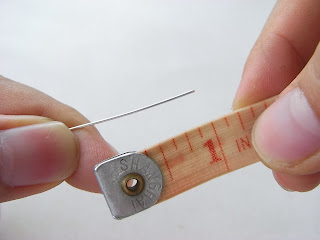


With your chain nose plier, grip onto the wire.....


.... and make a 90 degrees angle turn upwards.


For convenience sake, some people may use a round nose plier for the job since you will be using it to make the loop and would rather save the hassle of changing pliers.

But I like to use a chain nose plier for this kind of job because I feel that it gives me a more precise angle than a round nose plier.


Slide your bead back down and grip onto the other end of the wire.


With your chain nose, make another 90 degrees turn upwards for this other end and cut off at a desired length.


But of course you can always pre cut the desired length of wire first. I’ve just got the knack of working out from the spool but some may find it a bit difficult to work around since the spool of wire is constantly in the way. This may be especially true for beginners. So, maybe it would be a better idea for you to pre cut the wires out first and then take it from there. ;)

You might however want to have one side longer than the other, just in case if you want to make a wrapped loop for your tear drop bead since the short one will only be used to make a few wraps as the midpoint of the loop.

One thing to note though is that when you were making the bend on both sides of the wire, don’t bend it too close to the bead. You should leave a small gap on both sides so that your tear drop bead could dangle nicely later on. Also, be careful not to exert too much pressure or you might break the tip as I have done so many times!


Now that you have wires on both side of the bead. What you are going to do next is to cross these two wires to form an X.


Similarly, you might not want to cross it too close to the tip because you should have enough space for you to grip with while wrapping.

Ok, so now you have two crossed wire. One of it will be one which you will form the loop with and the other to make the wrap at the midpoint.

With these two wires, you are going to form a 90 degrees angle at the top of the bead by turning one of the wires down to form the horizontal line......


I know the picture here is a bit misleading since it doesn't look horizontal here but I'm talking in the sense that the bead is in an upright position, where bead is at the bottom and wire above. Try visualizing it, ya! And then you'll get what I mean. ;)


........ and another up to form the vertical line.


It doesn’t matter which wire to form the horizontal or the vertical one.

The vertical one will be the one you will be making the loop with and the horizontal one the one that you will be making the wrap with.

Here’s the 90 degrees angle at the tip.


With your round nose, grip at the bottom of the wires. Well, you can also use a chain nose. It doesn’t matter. I like to grip with my round nose and wrap with the chain nose. You may do it the other way round. It’s just a matter of preference at the end of the day.


Using the chain nose plier, grip onto the horizontal wire and wrap around the vertical wire.


Wrap as many or as little times around as you like and cut off the excess wrapping wire. Now, you are left with a single vertical wire with a wrapped bottom and reshape if necessary.


Well, I would say you have two options to finish it off here. You can either make a wrapped loop or a lolly loop with the wire. It makes not much difference really. A matter of preference, maybe? I made a comparison between the two types of loop here. So, if you are interested, you may want to give it a read.

Capped
This is probably one where you would see mostly used by wire jewellery artist, I reckon. It’s as though the wire wrappings formed some kind of bead cap at the top of the tip.

Basically what you will be doing is make a loop with one end of the wire and leave the other end of the wire much longer to make the ‘wrapped cap’.

Cut a 3” long wire. This is just a guide only. You may want to adjust accordingly to the size of the tear drop bead you are using or how long of a ‘wrapped cap’ you want to make. Here, I’m using an 11mm Swarovski tear drop bead.


Measure approximately 1” from the end of one of the wires.....


And make a 90 degrees bend.


Slide your bead in and we are going to make another 90 degrees bend on the other wire end. You may not necessarily use a tool each time for making the bend. Here, I’m showing how you can also make the bend with your thumb as well. The thumb, I find, to be presumably much gentler than the tools.


Unlike the earlier method, for this you may bend the side wires as close to the bead since the tip would be covered and the tear drop bead is not expected to dangle from the triangle frame other than from the loop joint above the bead.

Now, you will have two wires parallel to each other but one is longer than the other. The short one will be the one you will be making the loop with and the longer one will be the one for wrapping.


What you will be doing next is to cross the wires to form an ‘X’.


Turn the shorter wire such that it now forms a horizontal line.


The two wires need not necessarily form a 90 degrees angle here since it will make not much of a difference since the longer wire will eventually be used to make the wrapping downwards. It just so happens that the angle in which it was took appears to be so.


With your round nose plier, grip onto the shorter wire. We are now going to make a loop on the shorter wire.


Turn the wire around.


And form a loop


Alright, you are going to stop right here.


This is what you will get. The shorter wire somewhat parallel to one of the sides of the wire framing the tip of the bead.


See how the shorter wire is longer that the wire framing the tip of the bead?


We’ll need to cut the excess such that it should be at the least of the same length as the side wire.


Bend the longer wire downwards to form a horizontal line and this is somewhat of what you’ll get.


Okay, now we are going to make the wrapped cap. Here’s where the wrapping part begins. I used the round nose plier to grip onto the loop.


Be careful when you want to make the wrappings here though. As you can see, the longer wire is just a bend and without securing the bend as the midpoint, the wire tends to ‘run’. So, what you can do here is maybe to make a round at the bend to secure it as the midpoint for better grip while making the rest of the wrap.

What I normally do is to turn it upside down and grip the frame near the tip together with the shorter wire.


Make a single wrap around to secure all the wires together.


Turn back to the upright position and grip at the loop.


Now, start wrapping downwards.


Cut off the excess wires and do the necessary nip and tuck and this is the end product.


That’s all for the tear drop bead for this time. :)


post signature

Read More...

Related Posts Plugin for WordPress, Blogger...